


ESG compliance through precise as-built capture: your route to a sustainable property
The property industry faces a turning point in 2025: ESG criteria (environmental, social, governance) are no longer merely a “nice to have” but are becoming a legal obligation and a decisive competitive factor. For property owners and managers this means, in concrete terms: without dependable data on the sustainability of their buildings, they face not only regulatory consequences but also considerable loss of value. This is where 3D laser scanning comes in – as the key technology for sound ESG documentation.

What does ESG mean for your property?
ESG is more than a buzzword. Since 1 January 2025, companies with more than 250 employees or over 40 million euros in turnover have been obliged by the Corporate Sustainability Reporting Directive (CSRD) to publish detailed sustainability reports. This affects not only listed groups but increasingly medium-sized property companies too.
The three pillars in a property context:
- Environmental: energy efficiency, CO₂ emissions, resource consumption
- Social: user comfort, accessibility, health and safety
- Governance: transparency, compliance, risk management
The new reality: tighter requirements from 2025
The regulatory requirements have tightened considerably:
1. Energy efficiency standards
- New buildings must meet the Effizienzhaus 40 standard
- Existing buildings are subject to stricter refurbishment obligations
- The CO₂ price has risen to 55 euros per tonne
2. Extended reporting obligations
- Detailed disclosure of energy consumption
- Evidence of refurbishment measures
- Documentation of the CO₂ reduction strategy
3. EU taxonomy conformity
- Clear criteria for “sustainable” property
- Effects on financing and valuation
- Risk of “stranded assets” where requirements are not met

Why precise as-built data is the key
No ESG compliance without accurate building data – the equation is that simple. Yet many property owners face the problem that their as-built drawings are outdated, incomplete or simply missing. This is where 3D laser scanning comes in.
The benefits of precise as-built capture:
1. Sound energy analysis
- Exact capture of building envelopes and thermal bridges
- Precise area calculation for energy certificates
- Identification of refurbishment potential
2. Dependable documentation
- Legally sound evidence for authorities and investors
- Digital twin as a “single source of truth”
- The ability to compare over time
3. Optimised refurbishment planning
- A millimetre-accurate basis for specialist designers
- Avoidance of expensive design errors
- Efficient coordination of all trades
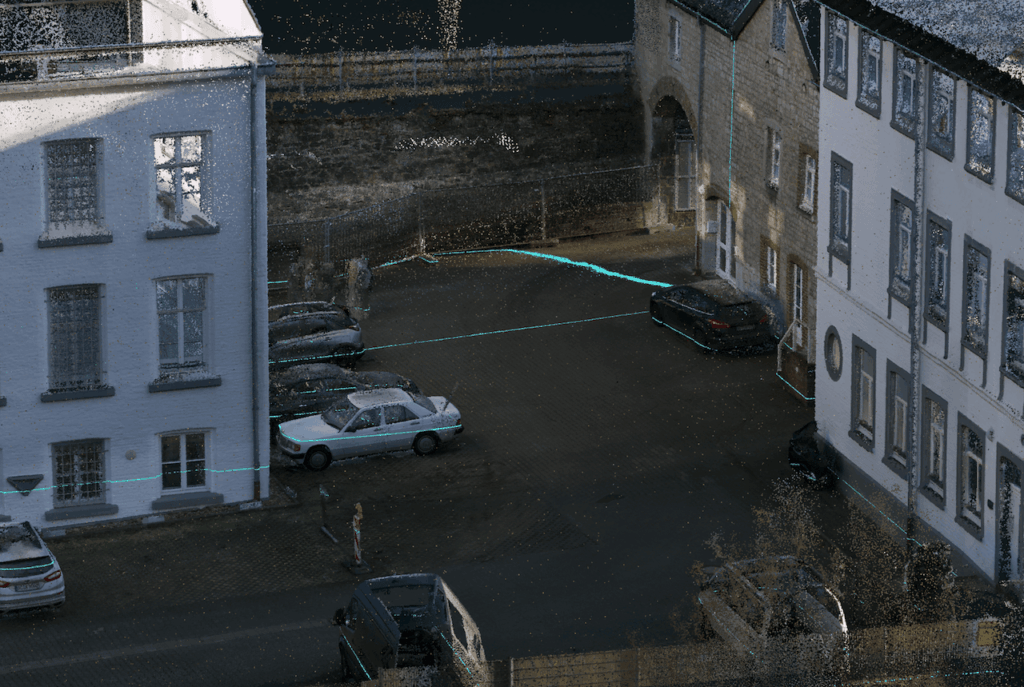
The route to an ESG-compliant property with 3D laser scanning
Step 1: as-built capture
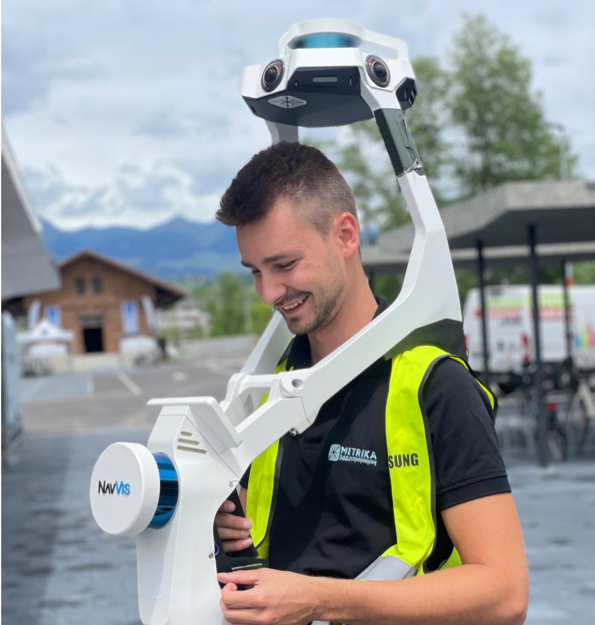
By means of mobile mapping or terrestrial laser scanning, your building is captured completely in digital form. The resulting point cloud reflects reality to an accuracy of a few millimetres.
Step 2: data evaluation
From the scan data:
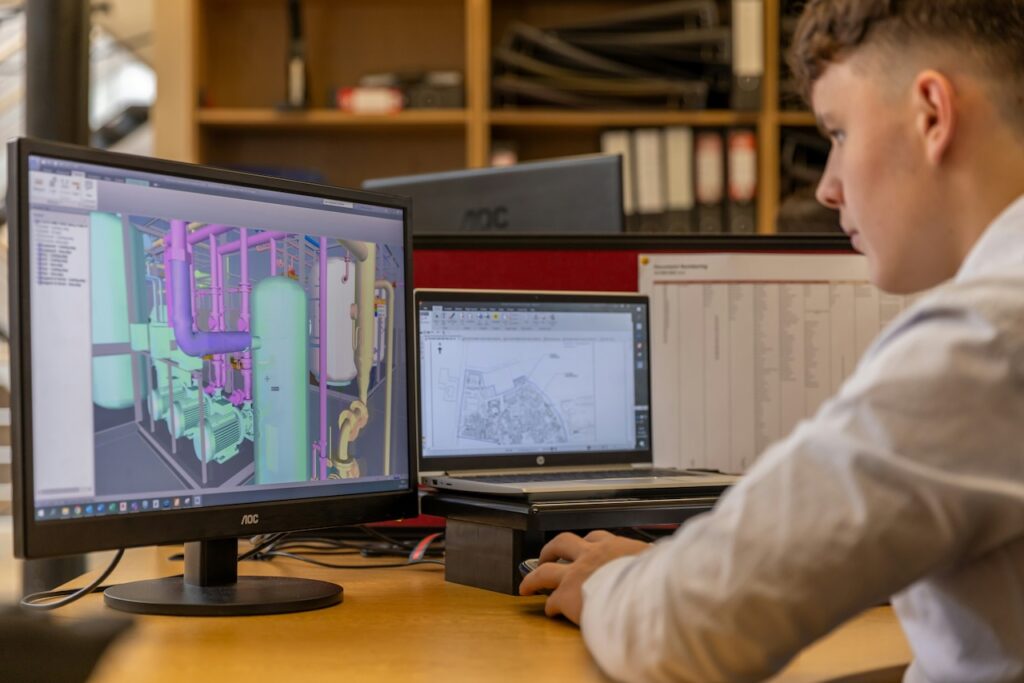
- Precise CAD drawings are produced
- Energy-relevant key figures are determined
- Weak points are identified
Step 3: ESG analysis
On the basis of the exact data:
- Calculation of the CO₂ footprint
- Simulation of refurbishment scenarios
- Cost-benefit analysis of the different measures
Step 4: planning the measures
- Prioritisation by ESG impact and ROI
- Drawing up a refurbishment roadmap
- Integration into ESG reporting
A practical example: an office complex becomes ESG-compliant
A medium-sized company faced the task of refurbishing its 1980s office complex to ESG standards. The existing drawings were incomplete and out of date.
The solution:
- Complete 3D capture in just 3 days
- Identification of 30% unused heated area
- Discovery of considerable thermal bridges
- Precise planning of the energy refurbishment
The result:
- 40% energy saving after refurbishment
- ESG rating improved from E to B
- 15% increase in the property’s value
- Payback on the investment in 7 years

Cost versus benefit: a clear calculation
Investment in precise as-built capture pays off several times over:
Direct savings:
- Avoidance of design errors (on average 5–10% of the construction sum)
- Optimised refurbishment measures
- Reduced energy costs
Indirect benefits:
- Increase in the property’s value
- Better financing terms
- Avoidance of penalty payments
- Preservation of lettability
Five concrete recommendations
- Carry out an as-built analysis:
Have the current ESG status of your property determined - Create the data basis:
Invest in a precise 3D as-built capture as the basis for everything that follows - Develop a refurbishment roadmap:
Prioritise measures by ESG impact and economic return - Use funding:
Benefit from state support for sustainable refurbishment - Monitor continuously:
Establish an ESG monitoring system for lasting compliance
The future belongs to sustainable property
ESG is here to stay. Properties that do not meet the new standards risk becoming “stranded assets” – hard to let, hard to finance, falling in value. The good news: with the right data and a well-considered strategy, the route to ESG compliance can be planned and made economically viable.
3D laser scanning is more than a surveying tool in this – it is the basis for sound decisions and for lasting growth in value. Because only those who really know their property can develop it to be fit for the future.
Ready for the next step?
Let us analyse together how your property becomes ESG-fit. Our experts are happy to advise you on the possibilities of digital as-built capture and will develop an individual roadmap to ESG compliance with you.