


MF-GIF: rental areas for commercial property
MF-GIF is the guideline of the Gesellschaft für Immobilienwirtschaftliche Forschung (gif, German Society of Property Researchers) for calculating rental areas in commercial property. It is not a DIN standard but an industry agreement – and that is precisely why it is common in leases.
Rental area is an allocation
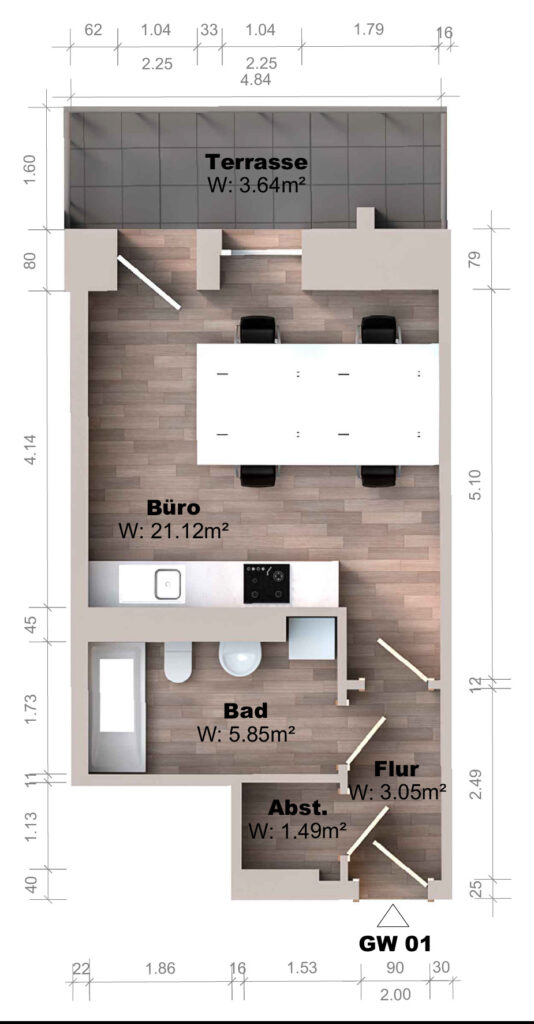
A plan shows rooms. Which of them the tenant pays for and what share of the common area is added is a matter of the guideline and is decided on this drawing.
What changed in 2023
Until then, several guidelines existed side by side: MF/G for commercial premises, MF/V for letting and MF/W for residential use. The 2023 edition merges them into one set of rules, so that mixed-use buildings can also be calculated consistently. The area types in it are called MF-GIF-0, MF-GIF-1 and MF-GIF-2.
In practice this means: older leases continue to refer to MF/G or MF/V, and then the edition named there applies. What counts is the contract, not the latest set of rules. That is why the edition belongs in the title block, and why “rental area according to gif” without stating the edition is an invitation to dispute.
Why there is a separate guideline
DIN 277 describes floor areas, but it says nothing about which area a tenant pays for. For residential space, the German Living Space Ordinance (WoFlV) fills this gap. For office, retail and logistics space, MF-GIF does: it defines which areas count as rental area, how common areas are apportioned and how to deal with areas that serve several tenants.
Why the survey decides
A rental area calculation needs more than external dimensions: it needs every area to be allocated to a rental unit or to the common areas. This allocation is made during the as-built survey and can only be established afterwards with renewed effort. If you need a rental area calculation, say so before the survey.
In disputes over rental areas or service charge allocation, a documented, traceable calculation at a defined point in time is the decisive factor.
Why an industry agreement and not a standard
MF-GIF does not apply by law. It applies because the lease refers to it. This is not a drawback but the reason for its wide use: it arose from letting practice and answers questions that a floor area standard does not even ask.
The structure: own area plus share
A tenant’s rental area consists of two parts. First, the area used exclusively by the tenant: their office, their storage, their sales floor. Second, a share of the areas everyone uses – entrance hall, corridors, sanitary areas, plant rooms, insofar as they serve the letting.
The share is distributed using an allocation key, usually in proportion to the exclusively used areas. This leads to something that surprises people in everyday practice: A tenant’s rental area changes without anything happening to their own space. If a neighbour moves out and their space is divided differently, the apportioned share shifts.
Relationship to DIN 277
The two do not contradict each other; they answer different questions. DIN 277 supplies the floor areas – the raw material. MF-GIF decides which of these areas are lettable and how they are allocated.
In practice, both figures are therefore derived from the same area calculation: the floor areas for operation, costs and CAFM, the rental areas for the lease. Collected separately, they would be two projects, with the risk that they do not match.
Where it gets stuck in practice
- Plant rooms. Whether a plant room serves the letting or the building is a matter of allocation, not measurement – and therefore negotiable.
- Areas for several but not all tenants. A corridor that serves only two of five units does not belong in the general allocation key.
- Basements and ancillary areas. Storage and archive areas are often valued differently from main usable areas.
- The plan as an annex. A schedule of areas without the plan it is based on cannot be verified. Both belong in the lease as annexes.
Related terms
Frequently asked questions
Is MF-GIF a standard?
No, it is a guideline of the Gesellschaft für Immobilienwirtschaftliche Forschung, i.e. an industry agreement. It becomes binding because leases refer to it.
What became of MF/G and MF/V?
The 2023 edition merges MF/G, MF/V and MF/W into one set of rules. Older leases continue to refer to the individual guidelines; in that case the edition named there applies.
Does MF-GIF also apply to residential space?
For the living area in leases and purchase contracts, the Living Space Ordinance (WoFlV) applies. MF-GIF covers the rental area in commercial and mixed-use buildings.
Does MF-GIF replace DIN 277?
No, it builds on it. DIN 277 supplies the floor areas; from these, MF-GIF determines the lettable area and the apportionment of the common areas.